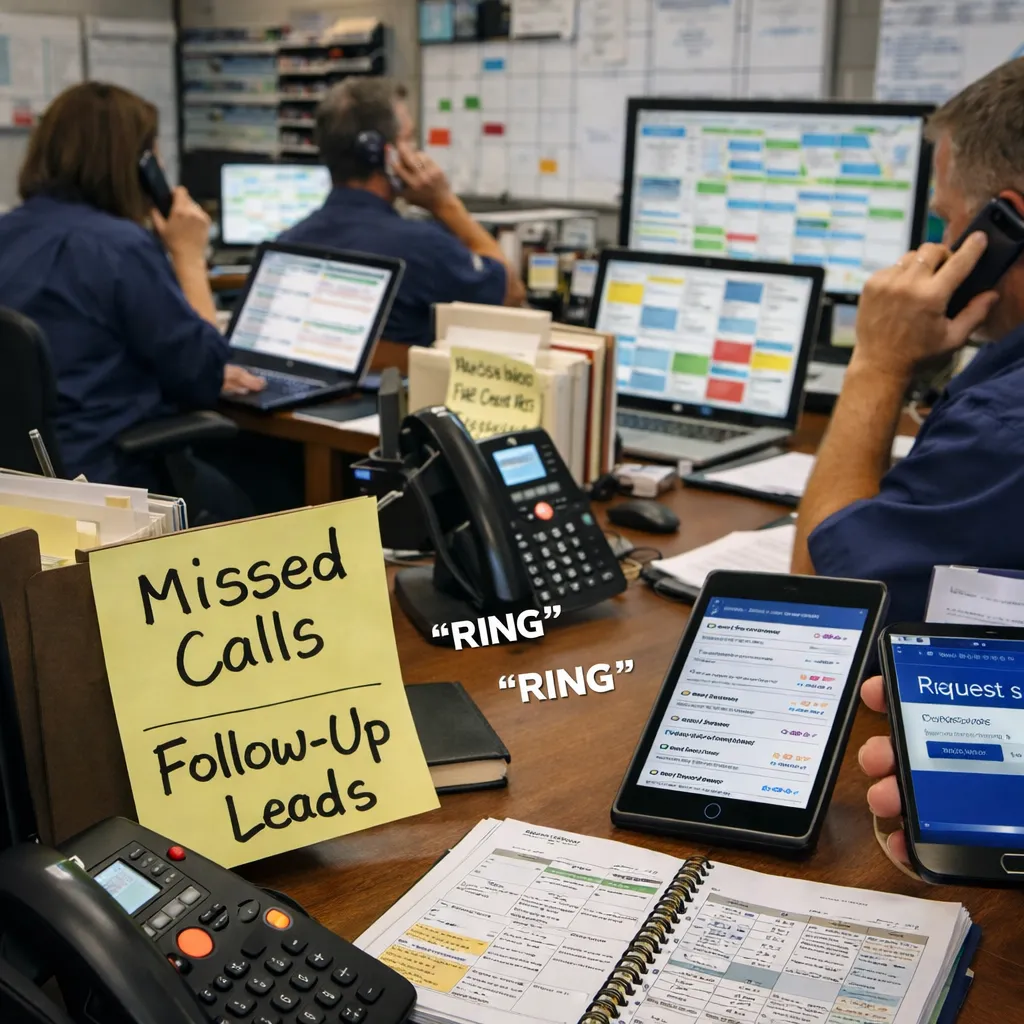
Why HVAC Offices Get Overloaded (And What It Costs Your Business)
Most HVAC offices don’t have a motivation problem.
They have a volume problem.
Too many calls.
Too many moving pieces.
Too many things are happening at once.
And not enough structure to handle it.
What’s really happening
From the outside, it looks like the office is just busy.
Phones ringing.
Schedules filling.
Dispatch is moving jobs around.
But inside that environment:
Calls get missed
Leads wait too long for a response
Follow-up gets pushed back
Small things get dropped
Not because people aren’t doing their job.
Because they’re doing too many at the same time.
When the office gets overloaded, response time is the first thing to break.
Response time.
Why this gets worse as you grow
Growth doesn’t just add revenue.
It adds pressure.
More inbound calls
More scheduling changes
More technician coordination
More customer communication
At a certain point, the office becomes the bottleneck.
And when that happens:
Response speed drops
Follow-up becomes inconsistent
Dispatch starts reacting instead of planning
Opportunities slip through
The business doesn’t feel like it’s growing.
It feels like it’s struggling to keep up.
What this looks like in a real HVAC office
A new lead comes in while dispatch is rescheduling jobs
A missed call doesn’t get returned until later (or at all)
A customer message sits while something more urgent takes priority
An estimate follow-up gets forgotten in the middle of the day
The team is constantly switching between tasks
Nothing is being ignored.
Everything is competing.
And once that happens, follow-up becomes inconsistent—and opportunities start disappearing quietly.
Follow-up becomes inconsistent.
What it actually costs
This is where overload turns into lost revenue.
Leads don’t get immediate responses
Calls go unanswered
Follow-up happens too late
Customers move on to the next company
You don’t see one big failure.
You see a steady leak.
And it shows up as:
Inconsistent booking
Unpredictable revenue
A constant feeling of being behind
Why pushing the team harder doesn’t fix it
Most owners respond by asking for more effort.
Move faster.
Stay on top of it.
Don’t miss anything.
But the issue isn’t effort.
It’s capacity.
You can’t expect consistent performance from a system that’s overloaded.
At some point, something gives.
And it’s usually your leads.
What strong operators do differently
They don’t try to “manage the chaos.”
They reduce it.
They build systems that support the office when things get busy.
Immediate response coverage
New leads don’t wait for someone to become available.
Missed call handling
Every missed call has a built-in recovery process.
Structured follow-up
Follow-up doesn’t depend on someone remembering later.
Clear task separation
Dispatch handles dispatch.
Lead handling follows a defined process.
Visibility across the board
You can see what’s happening without digging or guessing.
What changes when overload is removed
The office doesn’t feel calmer because there’s less work.
It feels calmer because the work is handled differently.
Response times improve
Fewer calls get missed
Follow-up becomes consistent
Dispatch runs more smoothly
The same volume becomes manageable.
The real issue
If your office feels constantly behind, it’s easy to assume the team needs to improve.
But most of the time:
They’re not slow.
They’re overloaded.
And without the right systems in place, that overload will keep costing you.
Conclusion
Growth puts pressure on your office.
If nothing is in place to support that pressure, things start to break.
Not all at once.
But consistently.
The goal isn’t to make your team work harder.
It’s to make the business easier to run under load.
CTA
If your office feels busy all day but results still feel inconsistent, the issue usually isn’t effort.
It’s how your system handles the workload.
HookWeb Design helps HVAC companies identify where calls, leads, and follow-ups are breaking down under pressure—and what needs to be in place to support real growth.
If you want to see where your system is overloaded, that’s exactly what the Growth Architect Audit is built for.
